

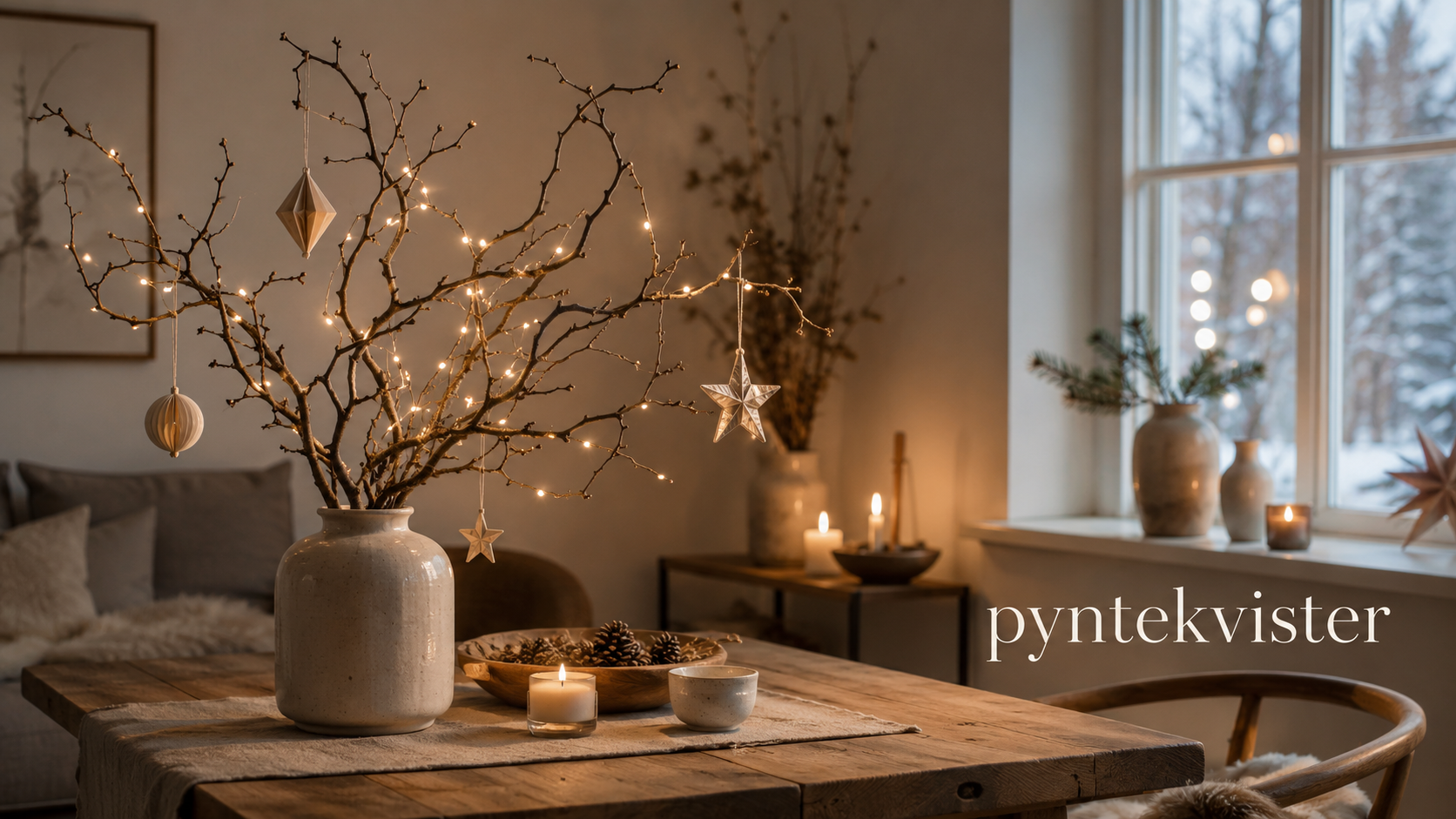
Walk into a Scandinavian home in December and you’ll probably spot them before anything else. Thin branches twisted into soft shapes, hanging above a dining table or standing in a ceramic vase beside a window. Tiny lights wrapped around them. Maybe paper stars. Maybe dried oranges. Nothing loud. Nothing trying too hard.
That’s pyntekvister.
The word comes from Norwegian and Danish roots. “Pynte” means decorate. “Kvister” means twigs or branches. Put together, it’s basically decorative branches. Sounds simple because it is simple. That’s the whole point.
But simplicity can carry a surprising amount of personality.
Where pyntekvister came from
Scandinavian interior design has always leaned toward natural materials. Long winters pushed people indoors for months at a time, so homes became important in a very practical way. You needed warmth, texture, and some sign that life still existed outside under all that snow.
Branches solved part of that problem.
People brought pieces of forests indoors long before “minimalism” became an Instagram category. Birch twigs, willow branches, pine clippings, and dried stems turned into decorations because they were available, cheap, and honestly pretty beautiful on their own.
Over time, pyntekvister became tied to seasonal decorating. Especially winter and Christmas.
And unlike giant plastic decorations that spend 11 months in a storage box, decorative twigs age well. A slightly crooked branch actually looks better than a perfect one. Nature already did the hard design work.
Why people still love them
A lot of modern décor feels manufactured down to the millimeter. Pyntekvister push in the opposite direction.
Every branch bends differently. Every knot and split creates texture you can’t fake.
That unpredictability matters. Human brains seem to relax around organic shapes. There’s a reason expensive restaurants put olive trees in corners and boutique hotels fill lobbies with dried branches taller than basketball players.
Twigs soften a room.
They also work almost anywhere. Tiny apartment in Oslo. Coffee shop in Copenhagen. Big suburban house in Toronto with heated bathroom floors and a Labrador named Frank. Decorative branches fit all of them.
And they cost almost nothing if you gather them yourself.
The materials people use
Birch is probably the classic choice. Scandinavian birch trees have pale bark that catches light really well, especially during dark winters.
Willow branches show up a lot too because they bend easily. You can shape them into circles, spirals, or loose arches without snapping them in half and questioning your life choices in the garage.
Then there’s pine, eucalyptus, hazel, dogwood, and cherry branches.
Some people leave them completely raw. Others paint them white, black, silver, or muted gold. Matte finishes usually look better than glossy ones. Glossy painted twigs can drift dangerously close to “mall holiday display from 2007.”
Dried flowers often get mixed in. Feathers too. Tiny glass ornaments if someone wants a Christmas look without hauling in a full-size tree.
Pyntekvister and Scandinavian minimalism
People misunderstand Scandinavian design all the time.
They think it means empty white rooms with 1 chair and emotional damage.
Real Scandinavian interiors usually feel warm. Textured blankets. Soft lighting. Wood everywhere. Ceramic mugs the size of soup bowls. Decorative branches fit naturally into that style because they add shape without visual chaos.
A single tall branch in a stone vase can change an entire corner of a room.
That’s why stylists use them constantly in Nordic homes. They draw the eye upward. They create movement. And they don’t clutter surfaces with random objects nobody actually likes.
There’s also a practical angle. Scandinavians tend to rotate seasonal decorations instead of permanently stuffing every shelf with trinkets. Twigs can change throughout the year.
Spring branches get blossoms.
Summer branches stay green.
Autumn branches collect dried leaves.
Winter branches get lights.
Same structure, different mood.
How people use pyntekvister at home
The easiest version takes about 5 minutes.
Find a branch with an interesting shape. Put it in a vase. Done.
Seriously.
But people build on that basic idea in creative ways.
Hanging decorations
Some suspend branches horizontally from the ceiling using thin fishing wire or natural rope. Then they hang ornaments, stars, paper birds, or tiny lanterns from the smaller twigs.
It looks especially good above dining tables because the branches create visual weight without blocking sightlines.
And unlike giant hanging fixtures, they don’t make guests feel like they’re eating beneath medieval weaponry.
Light installations
Fairy lights wrapped around branches are everywhere during Nordic winters.
Soft warm bulbs matter here. Bright blue-white LEDs can make a cozy room feel like a dentist’s office.
The branches diffuse light naturally, creating shadows that feel softer than normal lamps. That’s part of the appeal.
Wall arrangements
Some decorators mount branches directly onto walls as sculptural pieces.
Crooked driftwood works well for this. So do long bare branches with dramatic angles. Add linen ribbons or dried flowers and the whole thing starts looking like something from a boutique hotel charging $14 for sparkling water.
Seasonal centerpieces
Dining tables often get low arrangements made from short decorative twigs, candles, moss, and pinecones.
Nothing overly polished.
Actually, if it looks too perfect, it usually loses charm.
DIY culture around pyntekvister
Pinterest probably added fuel to the trend, but the DIY aspect existed long before social media.
People like making these because there’s very little pressure involved.
You aren’t carving marble statues. You’re arranging branches.
Kids can help. Grandparents can help. Someone who has never touched a glue gun in their life can still make something decent.
And because natural materials already contain texture and shape, mistakes rarely ruin the final result.
A bent branch still looks intentional.
That’s a pretty forgiving craft.
The environmental side
Decorative twigs also fit into modern sustainability habits.
Plastic holiday décor ages badly. Cheap glitter falls off. Artificial materials crack. Eventually everything ends up in storage bins or dumpsters.
Branches decompose naturally.
People reuse them for years or compost them afterward. Some even forage fallen branches after storms instead of buying anything at all.
That low-waste mindset connects strongly with Nordic design traditions. Scandinavia tends to value durability and restraint over constant replacement.
Buy less. Use longer. Keep things functional.
A branch from the woods fits that philosophy surprisingly well.
Social media changed the look
Instagram definitely polished pyntekvister into a global trend.
Search Scandinavian interiors online and you’ll see endless photos of airy apartments with decorative branches standing in oversized vases beside linen curtains.
Some of those setups look almost suspiciously perfect. Like nobody has ever spilled coffee there or owned a charging cable.
Still, social media helped spread the idea beyond Northern Europe.
Now you’ll see pyntekvister-inspired décor in Tokyo cafés, Brooklyn studios, and Australian beach houses. The branches change depending on local plants, but the concept stays recognizable.
Natural shapes. Minimal clutter. Quiet atmosphere.
Why pyntekvister work so well
Good décor doesn’t always scream for attention.
Sometimes it just changes how a room feels.
That’s what decorative branches do. They add height, texture, softness, and movement without dominating the space. And they do it using materials people normally step over during a walk outside.
There’s something refreshing about that.
A twisted branch doesn’t need branding or smart-home integration or an app connected to your phone. It just exists. Slightly uneven. Slightly imperfect. Better because of it.
Which is probably why pyntekvister have lasted this long.