

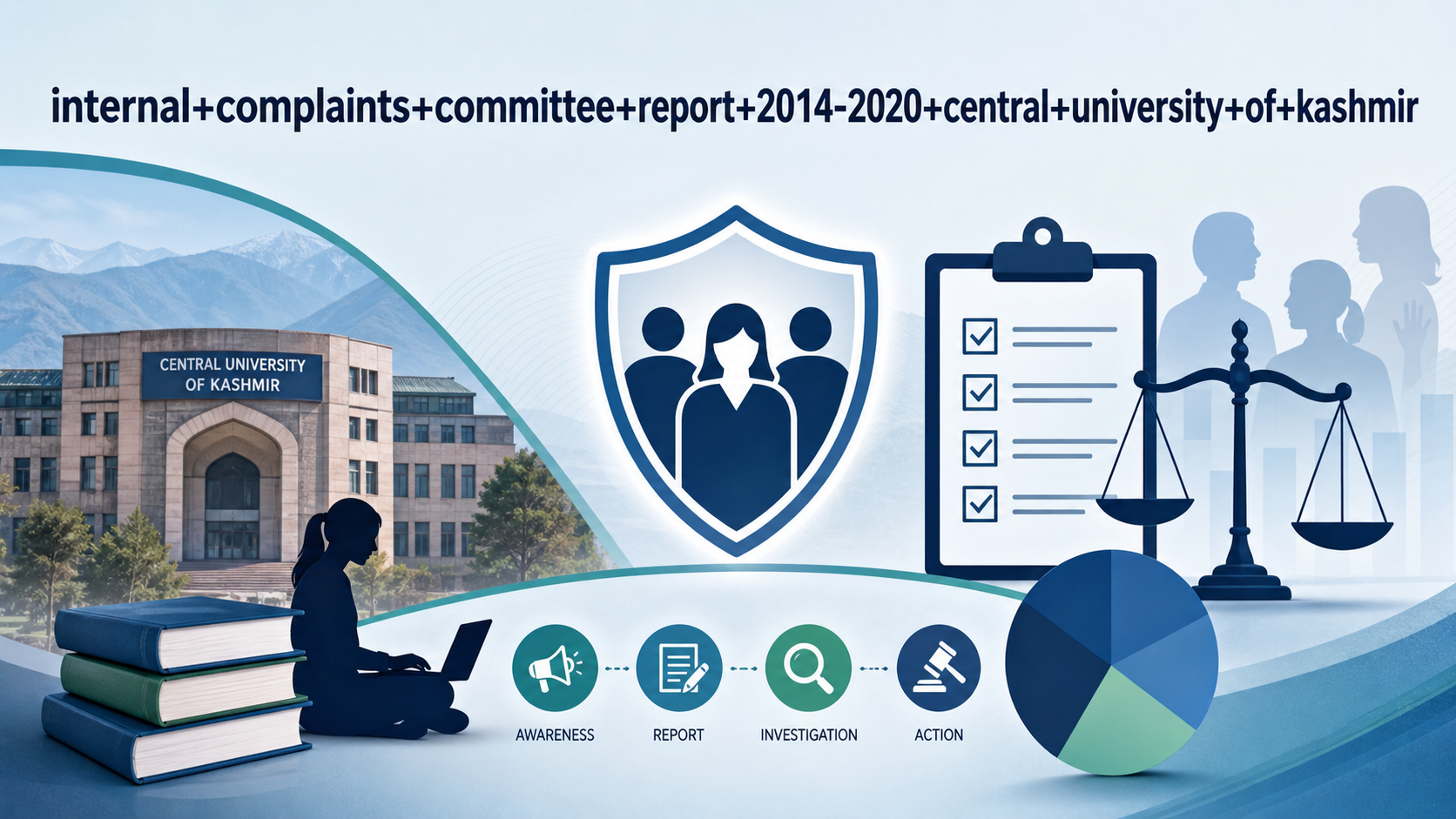
If you’re searching for internal+complaints+committee+report+2014-2020+central+university+of+kashmir, you’re probably not just looking for a formal summary. You want to understand what this report actually tells us—about safety, accountability, and how complaints are handled inside a university setting.
Let’s go beyond surface-level explanation and look at it in a way that’s actually useful.
What This Report Is Really About
At its core, the internal+complaints+committee+report+2014-2020+central+university+of+kashmir is a record of how the university dealt with complaints related to harassment and misconduct over a six-year period.
These reports are usually created to meet legal and institutional requirements, but they also serve another purpose: transparency. When done properly, they give insight into whether a system is working—or just existing on paper.
Most people expect such reports to simply list numbers. But the real value lies in what those numbers mean.
Understanding the Numbers Beyond the Surface
A common mistake is assuming that fewer complaints mean a safer environment. That’s not always true.
In many cases:
- Low complaint numbers can indicate fear, lack of awareness, or distrust in the system
- Higher complaint numbers might actually reflect better awareness and confidence in reporting mechanisms
So when reading the internal+complaints+committee+report+2014-2020+central+university+of+kashmir, it’s important to ask:
- Were awareness programs increasing over time?
- Did reporting trends change year by year?
- Were cases being resolved efficiently?
These questions matter more than the raw figures.
How Complaints Are Typically Handled
The process inside an ICC usually follows a structured path:
1. Filing the Complaint
A student or staff member submits a formal complaint. This step alone can be difficult due to fear of backlash or social pressure.
2. Initial Review
The committee checks whether the complaint falls within its scope.
3. Investigation
This involves interviews, evidence collection, and maintaining confidentiality.
4. Decision and Action
The committee recommends action—this could range from warnings to stricter disciplinary measures.
What’s important here is not just the process, but how fairly and quickly it is carried out. Reports like the internal+complaints+committee+report+2014-2020+central+university+of+kashmir often hint at this through resolution timelines and outcomes.
Practical Insight: What Most People Miss
Here’s something that doesn’t get talked about enough:
The presence of a committee doesn’t guarantee trust.
In many universities, ICCs exist formally, but:
- Students may not know how to approach them
- Staff may hesitate due to internal hierarchies
- Confidentiality concerns may discourage reporting
So when reviewing the internal+complaints+committee+report+2014-2020+central+university+of+kashmir, it’s useful to look for signs of outreach, such as:
- Workshops or awareness sessions
- Clear communication channels
- Gender sensitization programs
These are indicators of whether the system is actually accessible.
Common Issues Found in ICC Reports
Across institutions, including what can be inferred from the internal+complaints+committee+report+2014-2020+central+university+of+kashmir, some recurring challenges appear:
Lack of Awareness
Many students simply don’t know the ICC exists or what it does.
Fear of Retaliation
Even with formal protections, fear of academic or social consequences can stop people from reporting.
Delayed Resolutions
Investigations can take time, but long delays reduce trust in the system.
Underreporting
This is perhaps the biggest issue. What’s reported is often just a fraction of what actually happens.
Understanding these limitations helps you read the report with a more realistic perspective.
Pros and Cons of Such Reports
What’s Good
- Provides a documented record of complaints
- Shows whether the institution is taking action
- Helps identify trends over time
- Encourages accountability (at least on paper)
Where It Falls Short
- May not reflect unreported cases
- Often lacks detailed context
- Can be written in overly formal, hard-to-understand language
- Doesn’t always show the quality of investigations
So while the internal+complaints+committee+report+2014-2020+central+university+of+kashmir is useful, it shouldn’t be treated as the full picture.
How to Read This Report the Right Way
If you’re analyzing this report—whether for research, journalism, or personal understanding—here’s a simple approach:
Look for Trends, Not Just Totals
Compare year-by-year data instead of focusing on one number.
Check Resolution Rates
How many cases were actually resolved? That tells you a lot about efficiency.
Notice Awareness Efforts
An increase in workshops or campaigns often correlates with better reporting.
Pay Attention to Gaps
What’s not mentioned can be just as important as what is.
Why This Matters More Than It Seems
At first glance, something like the internal+complaints+committee+report+2014-2020+central+university+of+kashmir might feel like just another administrative document.
But it actually reflects something deeper:
how safe people feel in an educational environment.
Universities aren’t just about academics—they’re social spaces where trust, respect, and accountability matter. A well-functioning ICC contributes directly to that environment.
And when reports are transparent and honest, they build credibility.
Final Thoughts
The internal+complaints+committee+report+2014-2020+central+university+of+kashmir is not just about complaints—it’s about systems, behavior, and institutional responsibility.
If you approach it with the right mindset—looking beyond numbers, questioning patterns, and understanding context—you’ll get far more value from it than a basic summary could ever offer.
And that’s really the key:
don’t just read the report—interpret it.