
What “dōjin moe” actually means
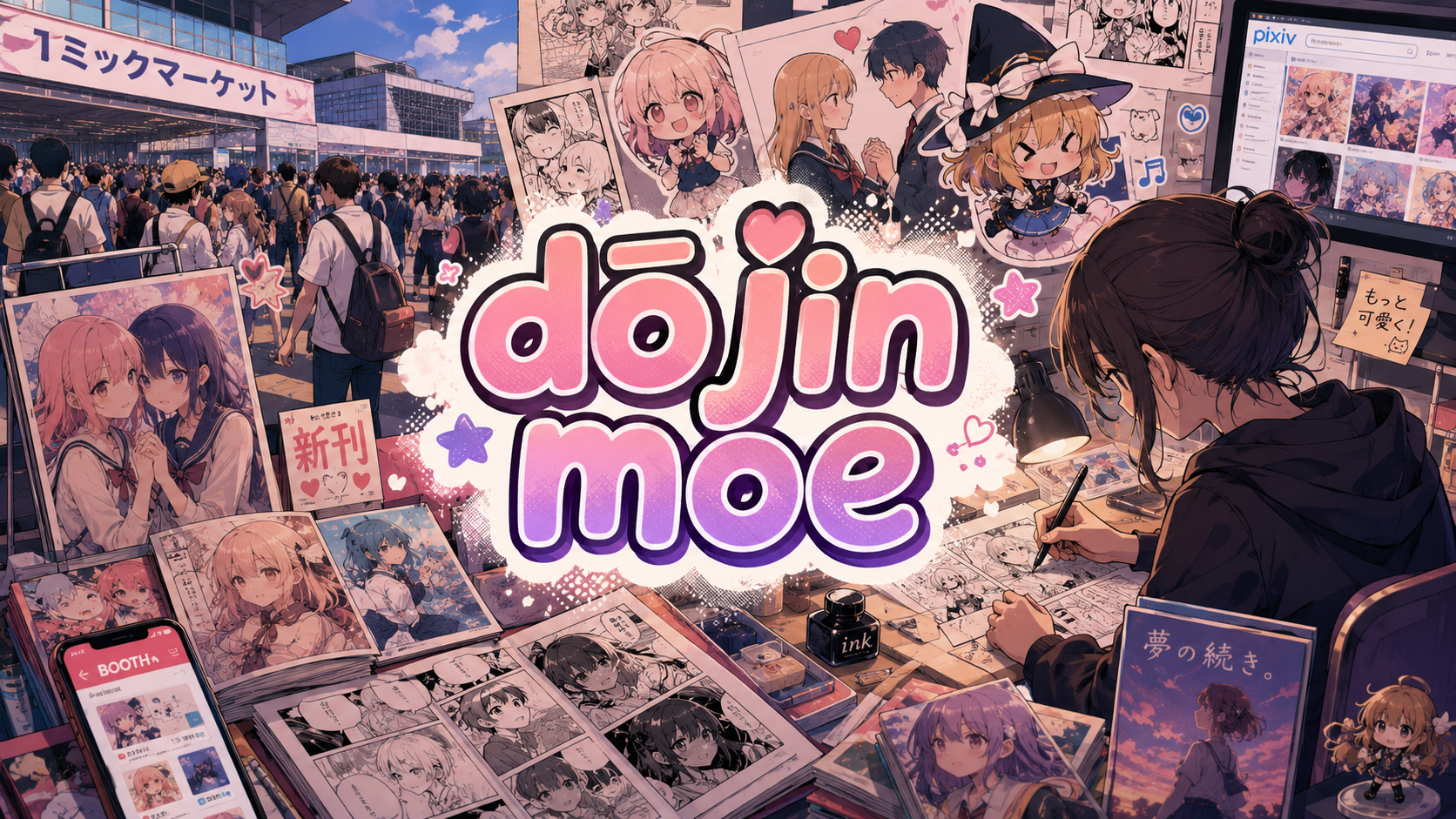
Dōjin moe sits at the intersection of two huge parts of Japanese fan culture.
“Dōjin” usually refers to self-published works. Manga, games, novels, art books, even music. Most are made by small circles of creators working outside major publishers. Some are original stories. Others remix existing anime, manga, or game characters.
“Moe” is harder to pin down. Anime fans have argued about it for years. In simple terms, it’s the emotional attachment people feel toward a character. Sometimes it’s affection. Sometimes protectiveness. Sometimes pure obsession over tiny character details, like the way someone ties their hair or says one specific line.
Put those together and you get dōjin moe: fan-made works built around emotional attachment to characters.
That sounds academic when you spell it out like that. In practice, it’s way messier and way more fun.
A single artist can draw a short comic about 2 background characters from a forgotten 2008 anime, print 100 copies, sell out at Comiket in 2 hours, and accidentally create a mini fandom. That’s dōjin moe.
The roots go back decades
A lot of people think this culture exploded with internet fandom. It didn’t.
Japan’s dōjin scene has existed since long before Twitter, Pixiv, or Discord. Comic markets in the 1970s already had fans trading self-made manga and parody works. Then anime fandom got bigger. Game fandom got bigger. Printing became cheaper. Everything snowballed.
The giant event everyone knows is Comiket, short for Comic Market. Thousands of creators gather there to sell books directly to fans. Some circles are tiny. Some later become professional studios.
And moe culture hit hard during the late 1990s and early 2000s.
Series like Lucky Star, K-On!, and The Melancholy of Haruhi Suzumiya pushed character-focused fandom into overdrive. Fans weren’t just following plots anymore. They latched onto personalities, reactions, habits, outfits, voice lines.
Dōjin creators noticed immediately.
If fans loved a character enough, they’d buy side stories, alternate romances, comedy sketches, slice-of-life extras, or ridiculous crossover scenarios. The official story became raw material.
Why people get attached to dōjin moe works
The emotional pull is the whole engine.
Big studios usually have deadlines, committee approvals, marketing pressure, broadcast limits. Dōjin creators don’t. They can chase one tiny emotional idea as far as they want.
Maybe someone wanted 40 extra pages about 2 side characters drinking coffee after school.
That sounds absurd until you remember fandom runs on absurdly specific emotional investments.
And dōjin creators often understand those investments better than companies do. They are fans first. You can feel it in the work.
Some dōjin artists spend years drawing the same character over and over, sanding down every expression until it feels perfect. Fans recognize that dedication instantly.
There’s also speed. A manga chapter from a major publisher might take weeks or months. Fan artists can react overnight.
An anime episode airs on Friday. By Sunday morning, somebody already made a parody comic where the villain works at a convenience store.
Internet culture made this even faster.
Sites like Pixiv and Booth gave artists direct access to audiences without needing a publisher standing in the middle.
The art style matters more than people admit
Moe aesthetics are incredibly recognizable once you notice the patterns.
Large eyes. Soft expressions. Rounded facial features. Emotional exaggeration. Tiny gestures that become personality markers.
A character adjusting oversized sleeves can become an entire fandom event. Anime fans operate on microscopic emotional signals.
Dōjin artists lean into this hard.
Some creators become famous for one thing only. Maybe they draw embarrassed expressions better than everyone else. Maybe they absolutely nail sleepy faces. Sounds silly, but fans remember.
And because the barrier to entry is lower than commercial publishing, styles get weird fast.
You’ll find polished digital art sitting next to photocopied sketch comics. Some books look studio-grade. Others look like they were assembled at 3 a.m. in a caffeine emergency.
Honestly, that unevenness is part of the appeal.
Romance dominates the scene
Romantic pairings fuel a massive chunk of dōjin moe culture.
Fans love asking the same question over and over: “What if these 2 characters got together?”
That question alone probably generated mountains of comics over the last 30 years.
Sometimes the pairing makes sense. Sometimes it absolutely does not.
A side character who appeared for 6 minutes total can still end up with thousands of fan illustrations if enough people latch onto the idea.
Shipping culture became so big that certain pairings practically developed their own economies at conventions. Dedicated sections. Dedicated artists. Dedicated buyers sprinting through crowded halls carrying tote bags full of books.
There’s a funny honesty to it all. Fans know they’re emotionally overinvested. They do it anyway.
Games pushed dōjin moe even further
Visual novels and anime-style games changed everything.
Series like Touhou Project became legendary in dōjin spaces because creators were unusually open about fan works. That openness triggered an avalanche of music remixes, comics, animation projects, and character reinterpretations.
Touhou especially became a machine for fan creativity.
Some fans entered through the games. Others only knew the fan art. A surprising number probably couldn’t even play the original bullet hell games properly. Didn’t matter.
The characters spread everywhere.
Then you had franchises like Fate/stay night and Kantai Collection feeding giant fan ecosystems packed with artists, cosplayers, and writers.
One successful character design could sustain years of dōjin output.
The internet changed the scale completely
Before social media, dōjin culture felt more local and harder to access outside Japan.
Now a single illustration can hit millions of views overnight.
Artists build international fanbases without speaking much English. Fans order books globally through proxy services. Digital releases made distribution easier than ever.
Platforms like DLsite became huge for independent creators selling games, comics, and voice works directly to audiences.
And algorithms reward strong character attachment. Moe-heavy art spreads fast because emotional readability spreads fast.
You see a cute expression once and your brain remembers it for days. That’s basically the entire system working as intended.
Critics and controversy never disappeared
Dōjin moe culture gets criticized constantly.
Some people think it encourages shallow attachment to fictional characters. Others think certain trends became repetitive or overly commercial. There are also ongoing debates around copyright and derivative works.
Japanese publishers usually tolerate fan works within limits because dōjin culture keeps fandoms alive and active. But the relationship has always been complicated.
There’s also the question of creative burnout.
A lot of dōjin artists work brutal schedules for relatively small returns. Printing costs are expensive. Convention prep is exhausting. Online audiences can be demanding in very weird ways.
Still, people keep making the work.
That persistence says a lot.
Why dōjin moe still matters
At its best, dōjin moe feels intensely human.
Someone cared enough about a fictional character to spend 20 hours drawing them smiling in a bookstore. Another person bought the comic because that exact emotional mood matched something they wanted to feel.
That connection matters, even if it sounds niche from the outside.
And the scene keeps feeding modern anime culture. Professional manga artists often started in dōjin circles. Animators borrow ideas from fan trends. Internet memes bounce back into official media all the time.
The line between fan and professional creator gets blurry fast.
A teenager drawing fan comics today could end up directing anime 10 years from now. That pipeline already happened many times.
Dōjin moe survives because fandom survives. People love characters. They always will.
Give fans enough emotional attachment and a cheap printing service, and they’ll build entire creative worlds on their own.