

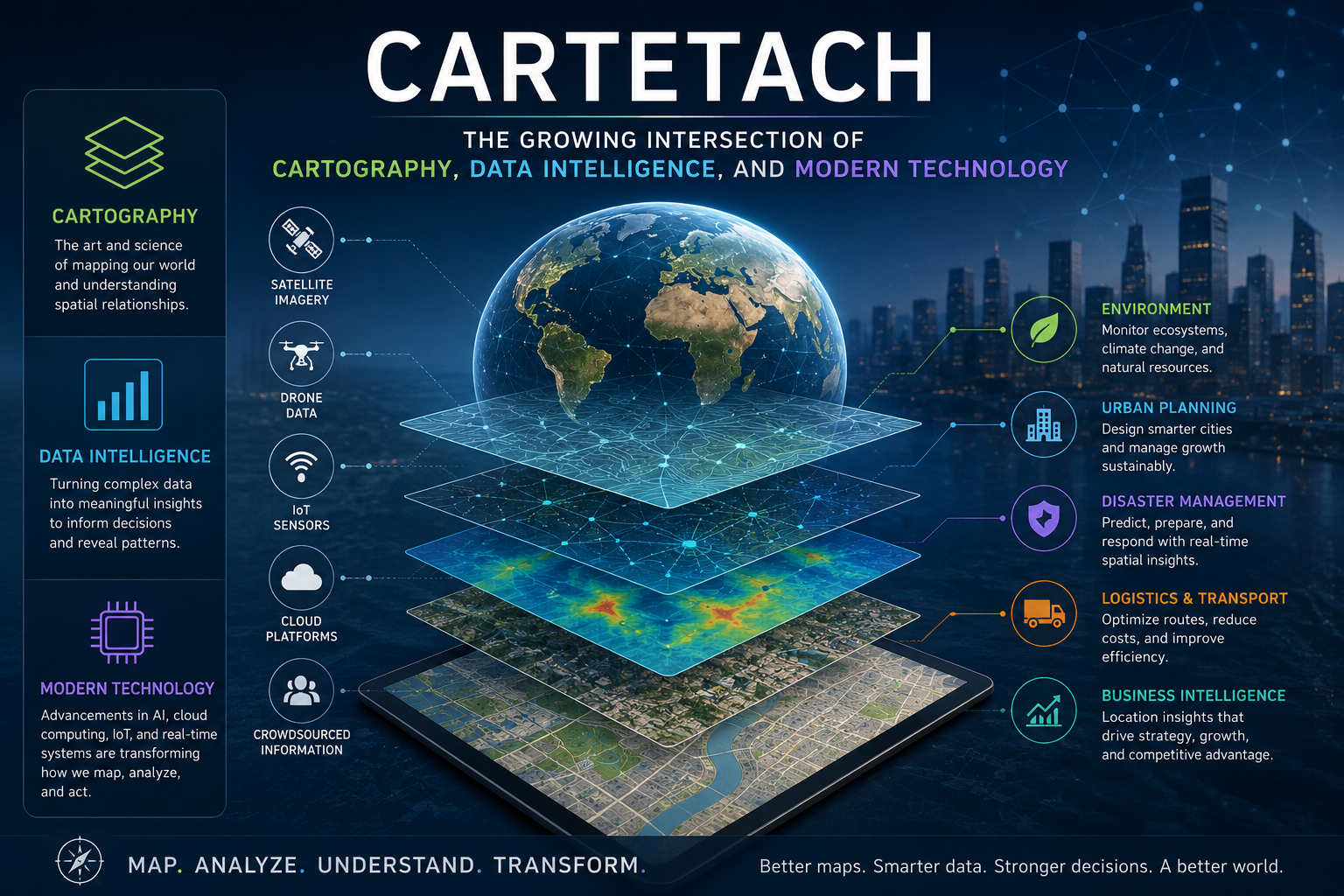
In an increasingly connected world, location has become one of the most valuable forms of information. From navigation apps and logistics networks to urban planning and environmental monitoring, geographic data influences countless decisions every day. Within this evolving landscape, the concept of Cartetach is emerging as a useful way to describe the convergence of cartography, digital mapping, data analytics, and advanced technology.
Rather than viewing maps as static visual references, Cartetach represents a modern approach in which geographic information becomes dynamic, interactive, and deeply integrated into decision-making processes. Organizations, governments, researchers, and consumers are increasingly relying on sophisticated mapping technologies that transform raw location data into actionable insights.
As digital transformation continues across industries, understanding Cartetach provides valuable perspective on how geographic intelligence is reshaping the way people navigate, plan, analyze, and interact with the world around them.
From Traditional Maps to Intelligent Geographic Systems
For centuries, maps served primarily as tools for navigation and geographic reference. Cartographers invested enormous effort in collecting measurements, documenting landscapes, and producing accurate representations of physical spaces.
The digital era fundamentally changed this process.
Satellite imagery, GPS technology, remote sensing systems, cloud computing, and mobile devices have transformed mapping into a continuously evolving data ecosystem. Modern maps no longer simply show locations; they can display traffic conditions, weather patterns, infrastructure status, demographic trends, and real-time movement.
Cartetach reflects this evolution by combining traditional geographic principles with technological capabilities that make location data more useful than ever before.
Today, a map can function as a business intelligence dashboard, an emergency response tool, a logistics optimization platform, or a predictive planning system.
The Core Components Behind Cartetach
Several technological disciplines work together to form the foundation of Cartetach.
Geographic Information Systems (GIS)
GIS platforms allow organizations to collect, store, analyze, and visualize spatial data. These systems make it possible to layer multiple data sources onto a single geographic framework.
For example, city planners may combine population density, transportation infrastructure, utility networks, and environmental data to identify optimal locations for future development.
Global Positioning Systems (GPS)
Accurate positioning technology enables real-time tracking and navigation. GPS data powers everything from ride-sharing applications to fleet management systems.
Without reliable positioning data, many modern Cartetach applications would not be possible.
Remote Sensing and Satellite Data
Satellites generate vast quantities of geographic information. High-resolution imagery can monitor agricultural conditions, urban expansion, forest health, coastline changes, and disaster impacts.
This information provides decision-makers with visibility into areas that would otherwise be difficult or costly to monitor.
Artificial Intelligence and Machine Learning
Artificial intelligence is increasingly being integrated into geographic systems. Machine learning algorithms can identify patterns within massive datasets, automate image analysis, predict traffic flows, and support forecasting models.
AI-driven geographic intelligence is becoming one of the most influential aspects of modern Cartetach solutions.
Why Location Intelligence Matters More Than Ever
One of the defining characteristics of Cartetach is its focus on location intelligence.
Every business activity occurs somewhere. Customers live in specific regions, supply chains move through transportation networks, and resources exist in physical locations. Understanding these spatial relationships can lead to more informed decisions.
Consider retail expansion. A company opening new stores may analyze demographics, income levels, traffic patterns, competitor locations, and population growth trends before selecting sites. Geographic analysis often reveals opportunities that traditional spreadsheets cannot easily identify.
Similarly, healthcare providers can use location data to identify underserved communities, helping improve resource allocation and patient access.
Location intelligence transforms geography from a background consideration into a strategic asset.
Cartetach in Business Operations
Businesses across virtually every sector are incorporating geographic technologies into their operations.
Logistics and Supply Chain Management
Efficient transportation depends heavily on location awareness.
Companies use advanced mapping systems to optimize routes, reduce fuel consumption, minimize delivery times, and improve fleet utilization.
Real-time tracking also enhances customer transparency by providing accurate delivery estimates and shipment visibility.
Retail and Consumer Analytics
Retail organizations increasingly rely on geographic data when selecting store locations, planning marketing campaigns, and understanding consumer behavior.
By analyzing regional trends and customer movement patterns, businesses can tailor products and services to local demand.
Real Estate Development
Developers use sophisticated mapping and spatial analysis tools to evaluate investment opportunities.
Factors such as accessibility, infrastructure, environmental risks, zoning regulations, and future growth projections can all be visualized geographically.
This approach improves planning accuracy and reduces uncertainty.
Smart Cities and Urban Transformation
One of the most visible applications of Cartetach is the development of smart cities.
Urban areas generate enormous amounts of data through transportation systems, utilities, public services, sensors, and connected devices. When integrated with geographic frameworks, this information can help cities operate more efficiently.
Examples include:
- Intelligent traffic management systems
- Public transportation optimization
- Infrastructure maintenance planning
- Energy consumption monitoring
- Emergency response coordination
- Environmental quality assessment
City leaders increasingly depend on spatial analytics to support sustainable growth while improving quality of life for residents.
As urban populations continue to expand, geographic intelligence will become even more important for managing complexity.
Environmental Monitoring and Sustainability
Environmental challenges often have strong geographic dimensions.
Climate change, deforestation, water management, biodiversity protection, and natural disaster preparedness all require accurate spatial information.
Cartetach technologies enable researchers and policymakers to monitor environmental conditions at local, regional, and global scales.
Satellite imagery can detect changes in vegetation cover. Geographic models can identify flood-prone areas. Spatial analysis can support conservation planning by revealing critical habitats and ecological corridors.
These capabilities help organizations move beyond reactive responses and toward proactive environmental management.
The Role of Real-Time Data
A major distinction between traditional mapping and modern Cartetach systems is the integration of real-time information.
Instead of relying solely on historical datasets, organizations can access continuously updated geographic intelligence.
Examples include:
- Live traffic conditions
- Weather developments
- Asset tracking
- Infrastructure performance
- Public transportation status
- Emergency incident reporting
This real-time perspective allows decision-makers to respond quickly to changing circumstances.
In many industries, the ability to act on current geographic information can significantly improve operational performance and risk management.
Challenges Facing Cartetach Adoption
Despite its advantages, Cartetach also presents several challenges.
Data Quality and Accuracy
Geographic analysis is only as reliable as the underlying data. Inaccurate, outdated, or incomplete datasets can lead to flawed conclusions.
Organizations must invest in data governance practices to maintain quality standards.
Privacy and Ethical Concerns
Location data often involves sensitive information about individuals and communities.
Responsible collection, storage, and use of geographic information are essential for maintaining public trust and regulatory compliance.
Technical Complexity
Advanced geographic systems frequently require specialized expertise.
Integrating mapping technologies with existing business processes can involve significant investment in infrastructure, training, and system development.
Data Integration
Many organizations operate across multiple data platforms.
Combining geographic information with operational, financial, customer, and environmental datasets remains a complex but increasingly important task.
Emerging Trends Shaping the Next Phase of Cartetach
Several developments are expected to influence the future direction of Cartetach.
Artificial intelligence will continue improving predictive geographic analysis. Digital twins—virtual representations of real-world environments—will become more sophisticated and widely adopted. Autonomous vehicles will rely heavily on advanced mapping systems. Augmented reality applications will increasingly integrate location-aware experiences.
At the same time, improvements in satellite technology, sensor networks, cloud computing, and edge processing will expand access to geographic intelligence across industries.
The result will be a more connected ecosystem where physical and digital environments interact seamlessly.
A Geographic Perspective for the Digital Age
Cartetach represents more than a technological trend. It reflects a broader shift in how organizations understand and use location-based information.
As geographic data becomes increasingly integrated with analytics, automation, and artificial intelligence, maps are evolving from passive reference tools into active decision-support systems.
Whether improving logistics operations, supporting environmental sustainability, guiding urban development, or enhancing customer experiences, Cartetach demonstrates the growing value of geographic intelligence in a data-driven world.
Organizations that successfully leverage these capabilities will be better positioned to understand complex systems, identify emerging opportunities, and make more informed decisions in an increasingly interconnected environment.