

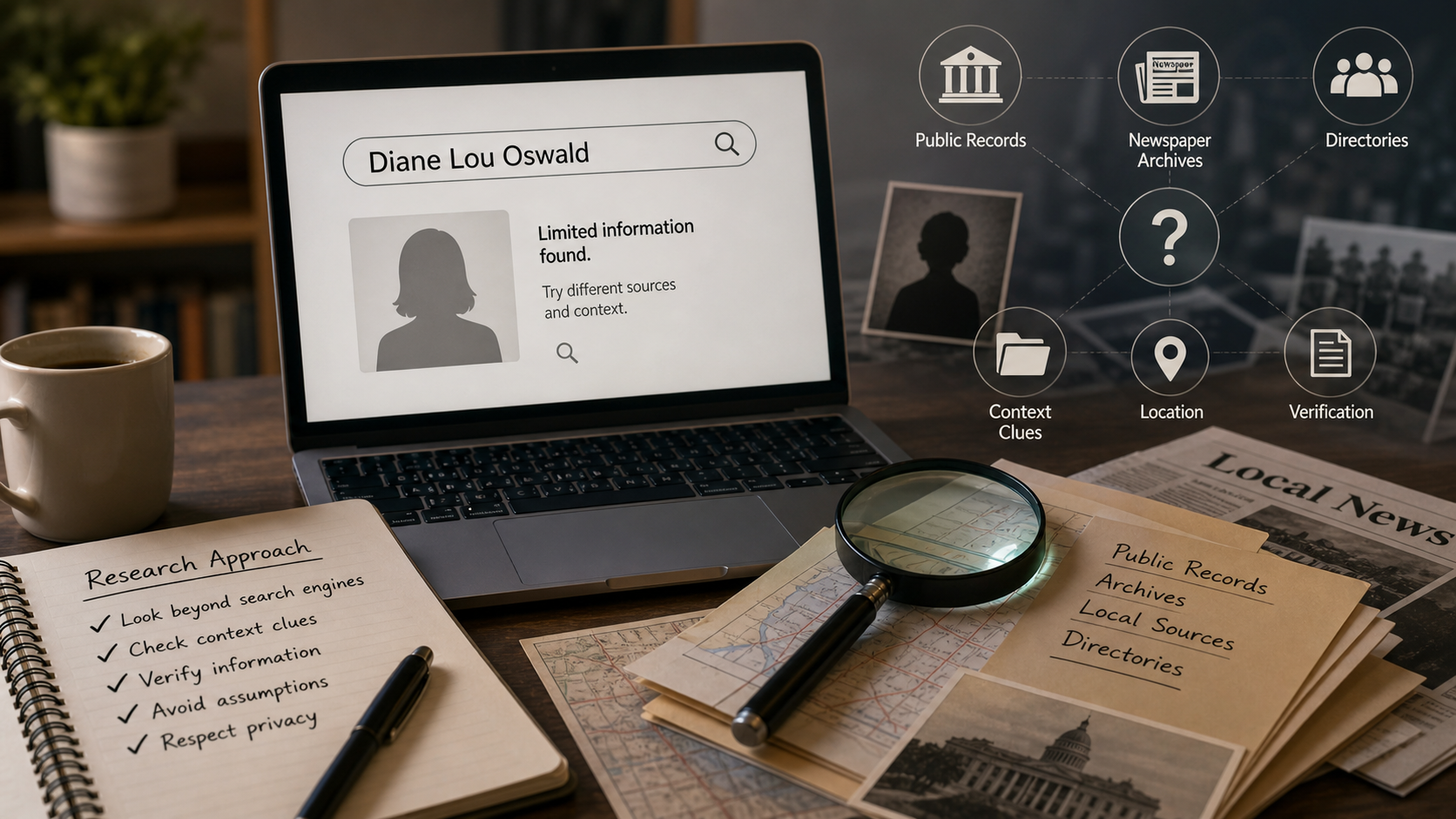
If you’ve searched for “diane lou oswald”, chances are you expected to find a clear biography, a list of achievements, or at least some solid public record. Instead, you may have run into something surprisingly common on the internet: a name with very little verified, consolidated information attached to it.
That can be frustrating. But it also opens up a more interesting conversation—about how we interpret limited data, how online identity works, and how to responsibly research individuals who aren’t widely documented.
Let’s take a closer look at what’s going on here, and how to make sense of it.
Why “Diane Lou Oswald” Is Hard to Pin Down
Not every name you search will belong to a widely documented public figure. In fact, most don’t.
When a name like diane lou oswald appears without a clear digital footprint, a few possibilities are usually at play:
- The person is a private individual with little or no public-facing presence
- Records may exist but are fragmented across local or offline sources
- The name could appear in niche contexts (legal filings, genealogy records, or local news)
- There may be multiple individuals with similar or identical names
Unlike celebrities or public professionals, private individuals don’t leave behind a neat trail of indexed information. That’s not a flaw in your search—it’s just how information ecosystems work.
Understanding Search Intent: What Are People Looking For?
When someone searches for diane lou oswald, they’re typically trying to answer one of these questions:
- Who is this person?
- Why is this name appearing in a document or search result?
- Is there any background or professional history available?
- Are there public records or affiliations tied to this name?
The challenge is that these questions assume there is a public narrative to uncover. Sometimes there simply isn’t—and that’s important to recognize early.
Practical Ways to Research a Name Like Diane Lou Oswald
If you genuinely need to learn more about someone with a limited online presence, a more deliberate approach helps. Here’s what actually works in real-world research situations.
1. Look Beyond Standard Search Engines
Basic search results only scratch the surface. Try:
- Public records databases (where legally accessible)
- Local government or municipal archives
- Academic or professional directories
- Newspaper archives (especially regional publications)
These sources often hold information that doesn’t rank highly on search engines but can be far more accurate.
2. Pay Attention to Context Clues
If you encountered the name diane lou oswald somewhere specific—a document, an article, a legal notice—go back and examine that context closely.
Ask yourself:
- What field or industry is this connected to?
- Is there a location mentioned?
- Are there associated names or organizations?
Even a small detail like a city or profession can dramatically narrow your search and lead to more relevant results.
3. Be Careful with Assumptions
One of the most common mistakes people make is assuming all instances of a name refer to the same person.
This is especially risky with:
- Common surnames
- Multi-part names (like Diane Lou Oswald)
- Older records where documentation standards varied
You might find multiple “matches” that are actually different individuals. Mixing them together leads to incorrect conclusions.
Common Mistakes People Make When Searching Names
This is where many searches go off track—not because the information isn’t available, but because of how it’s interpreted.
Mistake #1: Trusting Unverified Aggregator Sites
Some websites compile names with little context, often pulling from outdated or incomplete records. They may list:
- Addresses
- Possible relatives
- Age estimates
But these are frequently inaccurate or outdated.
Mistake #2: Expecting a Full Digital Profile
Not everyone has:
- Social media
- Published work
- Public-facing careers
Expecting a detailed online identity can lead to frustration and misinterpretation.
Mistake #3: Ignoring Privacy Boundaries
It’s easy to forget that behind every name is a real person. Digging too aggressively—especially without a clear reason—can cross ethical lines.
The Reality of Limited Information
Here’s the honest truth: sometimes, a search for diane lou oswald won’t lead to a detailed story, and that’s completely normal.
In fact, it reflects something important:
- The internet is not a complete record of humanity
- Many lives are intentionally private or simply undocumented online
- Absence of information does not imply anything negative
This can feel unsatisfying, but it’s also a useful reminder not to overinterpret gaps.
Pros and Cons of Searching Lesser-Known Names
The Upside
- You avoid misinformation overload (common with famous names)
- Any verified data you find tends to be more meaningful
- You develop stronger research habits
The Downside
- Information can be fragmented or incomplete
- Verification becomes harder
- You may not reach a definitive answer
When You Should Keep Searching—and When to Stop
A good rule of thumb:
Keep searching if:
- You have a legitimate reason (legal, academic, personal connection)
- New leads keep appearing
- You’re working with reliable sources
Step back if:
- You’re relying on guesswork
- Results become repetitive or vague
- You’re crossing into speculation
Knowing when to stop is just as important as knowing how to search.
A More Grounded Way to Think About It
Searching for a name like diane lou oswald isn’t just about finding information—it’s about understanding how information exists.
Some people leave behind books, interviews, and public records. Others leave only small traces, scattered across systems not designed for easy discovery.
And that’s not a problem to solve—it’s just reality.
Final Thoughts
If you came here hoping for a detailed biography of diane lou oswald, the honest answer is that publicly available, verified information appears to be limited or fragmented.
But there’s still value in the process:
- You learn how to research responsibly
- You avoid common misinformation traps
- You develop a clearer sense of how digital identity works
Sometimes, the most useful insight isn’t the information you find—it’s understanding why it’s hard to find in the first place.